“How Smart Parents Are Reducing Their Child’s Mobile Addiction in Just 7 Days — Without Fights, Crying, or Taking the Phone Away”
A simple daily action plan for parents to reduce screen time, improve focus, and bring back real-world play — even if your child is fully hooked.
हिंदी में पढ़ने के लिए यहां क्लिक करें
Join Whatsapp Community
and Get Support & Free Activity Sheets
Proven strategies
Easy to implement
Risk Free
Used by 15,000+ Parents to Reduce Screen Time at Home
The Digital Epidemic Stealing Your Child's Childhood
Today's children spend an average of 7+ hours daily on screens -that'sover 2,500 hours per year of lost childhood experiences.
7.5 hrs
Average daily screen time for children ages 8-12
60%
Of parents report daily battles over device usage
42%
Decline in children's creative play since 2000
What's Really Happening to Your Child?

Attention Hijacking
Apps and games are designed with the same psychological tricks used in casinos to keep your child's brain craving more screen time.
Creativity Killer
Passive consumption replaces active imagination, reducing your child's ability to develop crucial creative thinking skills.
Emotional Detachment
Screen addiction reduces face-to-face interaction, causing children to miss crucial emotional development opportunities.
Family Disconnect
Family bonds weaken as screens replace conversations, shared activities, and meaningful interactions.
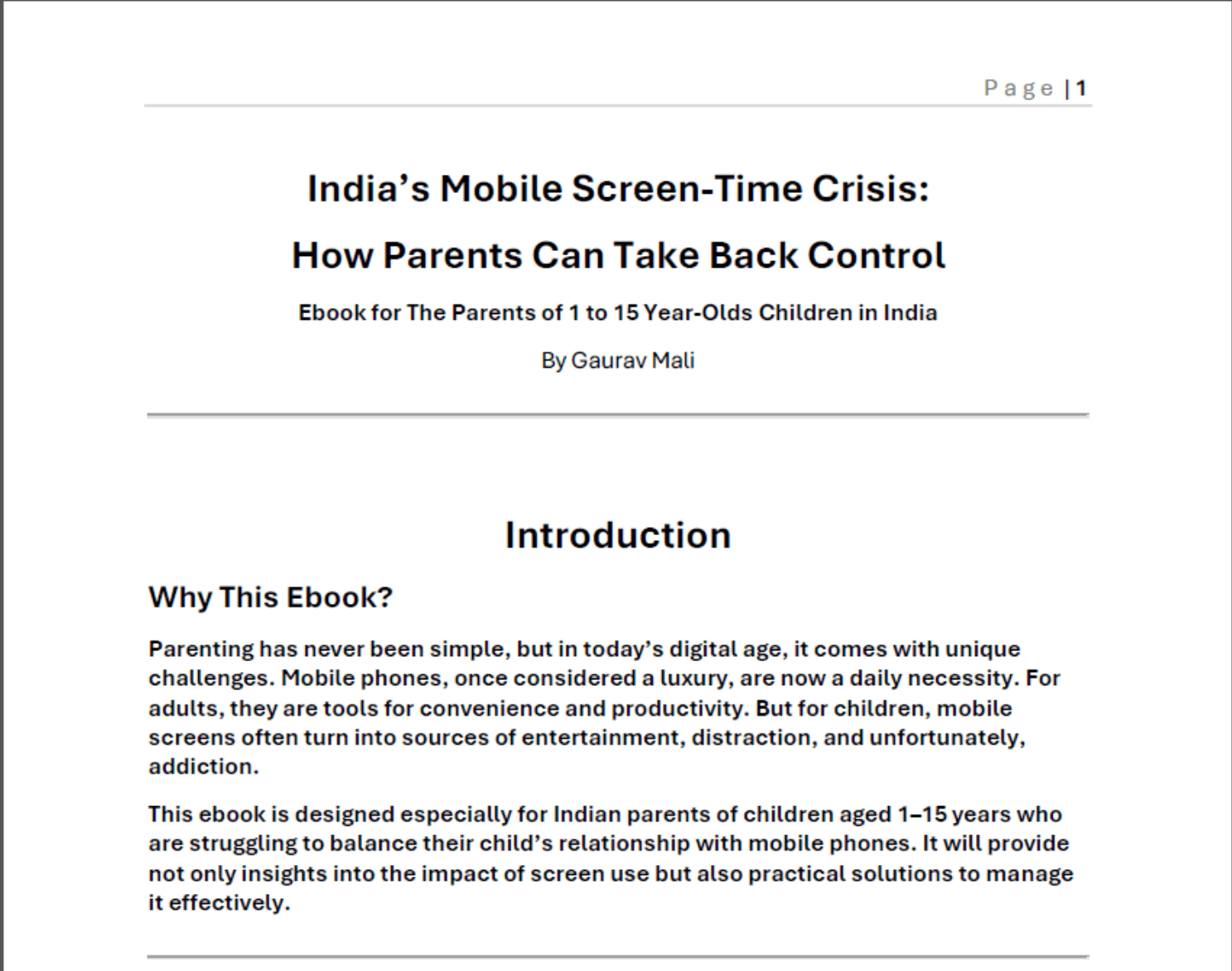

What You'll Discover Inside:
Psychology & Screen Rules
A simple, proven framework that helps you understand the Psychology of Children by their age & according that
you will fix their SCREEN TIME.
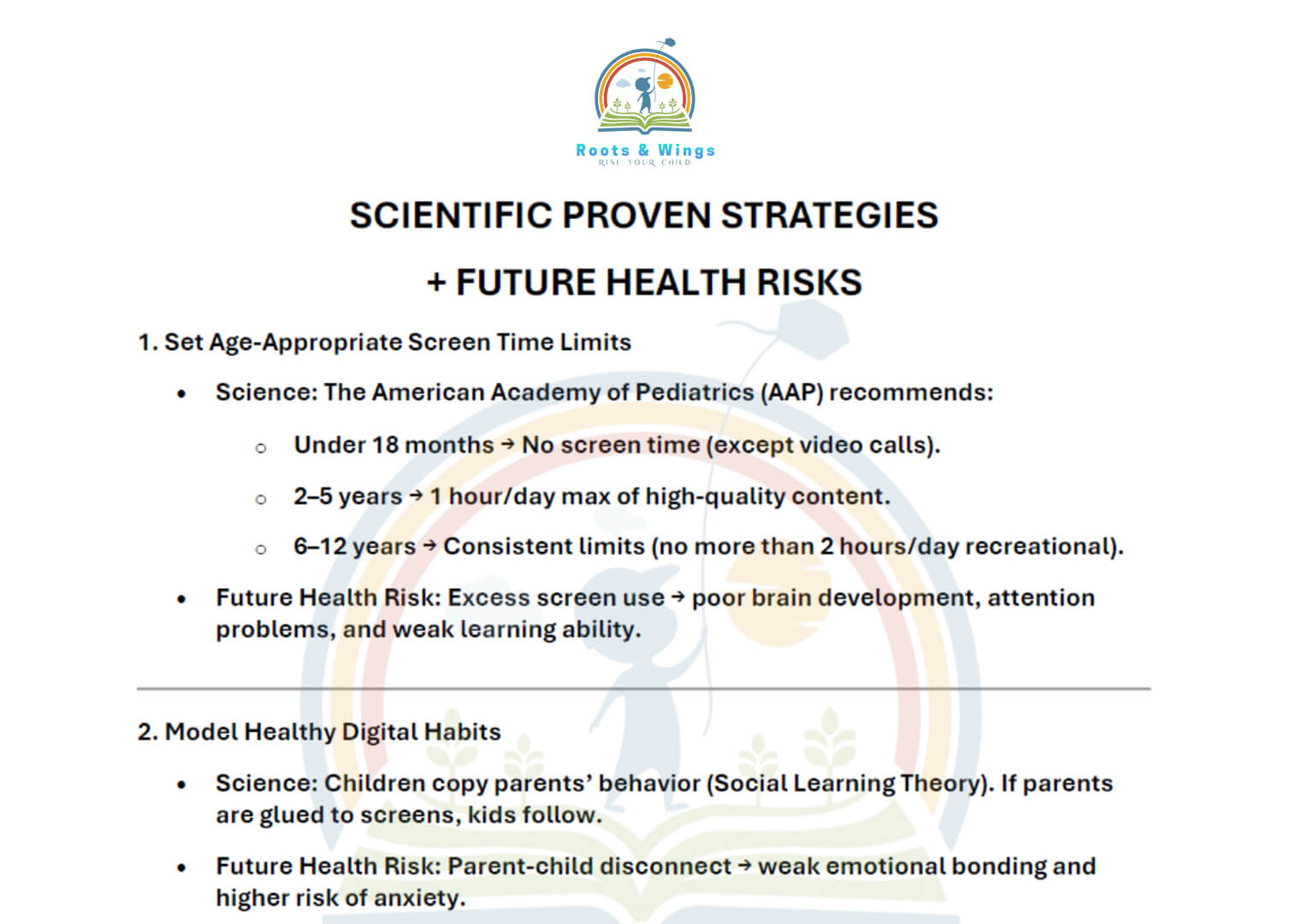
Proven Strategies
After Positive approval of Child Experts, this E Book is filled with different Scientific Proven Strategies to handle every age bar of child to manage with MOBILE ADDICTION.
Family Reconnection Blueprint
Step-by-step guide to restore meaningful Family Connections, Rebuild Trust, and create moments your children will remember forever.
Tech-Balance Scripts & Templates
Word-for-word conversations to have with your child at different ages to create healthy technology boundaries without resistance.
The Transformation
From Digital Zombie to Thriving Child
See the difference when you apply the principles in our free guide
Before
Life With Digital Dependency
- Morning battles to get ready for school while your child begs for "just 5 more minutes" on their device
- Dinner time filled with glazed eyes and monosyllabic responses as your child mentally remains in the digital world
- Explosive meltdowns when it's time to disconnect, making you feel like the "bad guy"
- Constant complaints of boredom when not on screens, with seemingly no interest in other activities
- Feeling like you're losing your child to a digital world you don't understand or control
- Nagging worry about your child's development and the long-term effects of excessive screen time
After
Life After Digital Transformation
- Morning battles to get ready for school while your child begs for "just 5 more minutes" on their device
- Dinner time filled with glazed eyes and monosyllabic responses as your child mentally remains in the digital world
- Explosive meltdowns when it's time to disconnect, making you feel like the "bad guy"
- Constant complaints of boredom when not on screens, with seemingly no interest in other activities
- Feeling like you're losing your child to a digital world you don't understand or control
- Nagging worry about your child's development and the long-term effects of excessive screen time
Join thousands of parents who've reclaimed their children's childhood

Learned & Certified by India's No.1 Parenting Coach - Mr. Parikshit Joban Putra
Frequently Asked Questions
Will This Work For My Family?
Answers to your most common questions
What age children is this guide designed for?
The guide includes specific strategies for children ages 3-16, with separate sections tailored to preschoolers (3-5), elementary age (6-10), and teens (11-16). Each age group faces unique challenges with screens, and the guide provides age-appropriate approaches for each developmental stage.
My child has a complete meltdown when I try to limit screen time. Will this really help?
Absolutely! Meltdowns are actually one of the most common symptoms of unhealthy screen dependency. The guide includes specific de-escalation techniques and transition strategies designed to minimize and eventually eliminate these emotional outbursts. The 3-Step Reconnection Method specifically addresses how to break the cycle of screen-related tantrums while strengthening your relationship with your child.
I use screens to get things done. Won't limiting them make my life harder?
This is a common concern! The guide doesn't suggest eliminating screens entirely (that's unrealistic in today's world). Instead, it provides a balanced approach that includes strategies for independence-building activities that don't require your constant supervision. Many parents find that after implementing these techniques, their children actually become more self-sufficient and less demanding overall, giving you more time, not less.
Is this going to be a lot of work to implement?
The guide is specifically designed for busy parents. It includes a simple 7-day implementation plan that requires just 15-20 minutes of focused effort each day. You'll see initial improvements within days, not weeks or months. The step-by-step approach means you won't feel overwhelmed with changes, and the done-for-you scripts and activities mean you don't have to create anything from scratch.
My child needs screens for school. How does that fit in?
The guide makes an important distinction between productive screen use (learning, creating, connecting) and passive consumption (mindless scrolling, excessive gaming, binge-watching). You'll learn strategies for encouraging healthy, educational screen time while limiting entertainment-based screen time. The guide includes specific sections on balancing school-related technology with offline activities.
Will I have to completely change our family routines?
The framework is designed to integrate into your existing family life, not completely overhaul it. You'll learn how to make strategic adjustments to your current routines that create significant positive changes without turning your household upside down. The guide includes specific strategies for different family situations, including single parents, working parents, and multi-child households.
Take the First Step to Change Child Daily Activities
and Manage Screen Time with
"Scientifically Proven : Activity Based Practical E Book for Parents"
You Get this Ebook only at Rs. 99/- Only
Ebook Price Worth Rs. 1199/-
With 7 Days Money Back Guarantee